
Jessica Del Sole


Jessica Del Sole, a public school teacher at Topcliff Public Elementary School in Toronto’s Jane and Finch community, has spent the past decade developing a practice rooted in environmental education, land-based learning, and a growing understanding of Traditional and Indigenous Knowledge Systems.
As a white settler on Turtle Island, Jessica’s journey has been shaped by an ongoing question: how can settlers engage ethically and respectfully with Traditional and Indigenous Knowledge through relationship with Land, Water, and community?
Her environmental education journey began through her leadership of the school’s Eco Club and deepened when she completed an Additional Qualification course in Environmental Education through OISE/U of T. There, she was introduced to the concept of Land as Pedagogy — an approach that fundamentally shifted how she understood learning, place, and relationship.
Since then, Jessica has continued to learn with and from Elders and Knowledge Keepers, through storytelling, land-based experiences, professional learning, and community partnerships.
In the school community, Jessica works in partnership with the Eco Club and Staff Indigenous Committee. This connects environmental education with Traditional Knowledge, and broader curriculum goals.
For this work, Jessica was named runner-up for the 2026 Edward Burtynsky Award for Teaching Excellence in Environmental Education.
Branch 1: Inquiry and Engagement / Lighting the Fire
Curiosity is the starting point for Jessica’s environmental education practice. She creates opportunities for students to ask questions, develop personal relationships with the natural world, and investigate the living systems that surround them.
At Topcliff Public Elementary School, Jessica co-wrote and led the implementation of a TD Friends of the Environment grant that supported the creation of a restorative community garden and partnership with woodland artist, Elder Philip Cote.
The garden became much more than a place to grow plants. Students learned that plants can be understood as relatives, part of a loving family. Each student was invited to choose a plant that “spoke to them,” research it, and create an infographic illustrating and describing what they had learned. Students explored species including woodland sunflower, swamp milkweed, and purple aster. Through this process, scientific investigation became connected to questions of relationship, responsibility, and community.

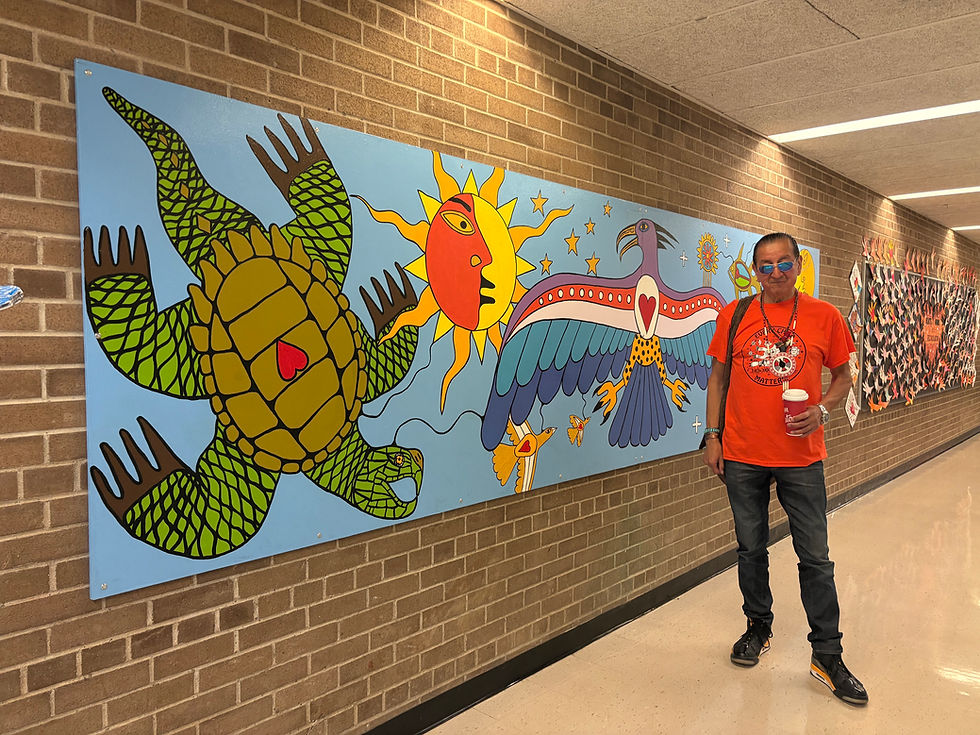
Elder Philip Cote created opportunities for students and staff to experience woodland art and traditional teachings. This included transformative Orange Shirt Day presentations, smudging, drumming, storytelling, and school-wide learning. Elder Cote’s two-year collaboration with the school also contributed to the creation of the mural Knowledge of the Wisdom Keepers.
Through these experiences, students were encouraged to see the environment not simply as something to study, but as a community of interconnected relationships.
Branch 2: Experiential Learning / Sending Out Roots
Jessica’s environmental education practice is grounded in hands-on and hearts-on experiences. While teaching Kindergarten, she used the schoolyard and the nearby Black Creek/Downsview Ravine as an extension of the classroom. Students explored the changing seasons, observed wildlife and animal tracks, discovered serviceberries, sugar maples, and oak trees, and collected natural objects that became part of mathematics learning.
The natural environment became both a source of questions and a teacher in its own right.
With support from Learning for a Sustainable Future, Jessica also developed a project that invited students to expand their understanding of “community” to include the more-than-human world. Working with Recreate Place, Kindergarten students explored bird protection and created bird-silhouette window collages designed to reduce bird strikes. The project connected directly to the school’s restorative garden. Protecting birds, supporting pollinators, and cultivating plants became interconnected actions rather than isolated environmental activities.
Students learned that hummingbirds and other pollinators rely on healthy habitats, just as humans do. Through observing the seasons, asking questions, caring for living things, and taking action, students developed a stronger sense of place and belonging.
For Jessica, these experiences are about allowing students to “send out their roots” — developing relationships with the places they inhabit and allowing those relationships to guide their learning.
Branch 3: Integrated Learning / The Flow of Knowledge
Environmental education flows across Jessica’s classroom and school-wide practice rather than existing as a stand-alone subject.
Her students have visited Black Creek Community Farm to explore sustainable agriculture, community gardens, worm composting, greenhouses, and traditional structures. These visits gave students opportunities to connect classroom learning with the land and with environmental practices taking place within their own community.
Jessica has also brought this learning to colleagues. As part of her collaborative school leadership, she organized professional development with Knowledge Keepers who introduced staff to Traditional Ecological Knowledge (TEK). Together, these experiences have helped educators consider how environmental learning can move across subject areas and become part of the culture of a school.
In the classroom, environmental inquiry has included mathematics, science, literacy, art, and social learning. Students have used natural materials for mathematical investigations, created artwork inspired by the natural world, researched plants, written poetry, explored biodiversity, and investigated relationships between species.
School-wide book studies have extended these connections even further. Through Be a Good Ancestor by Gabrielle Prince and Leona Prince, students explored ideas of ancestors, presence, future generations, and relationships with land. Nature walks along the Black Creek Ravine became opportunities to collect rocks, which students later painted and incorporated into a school library display.


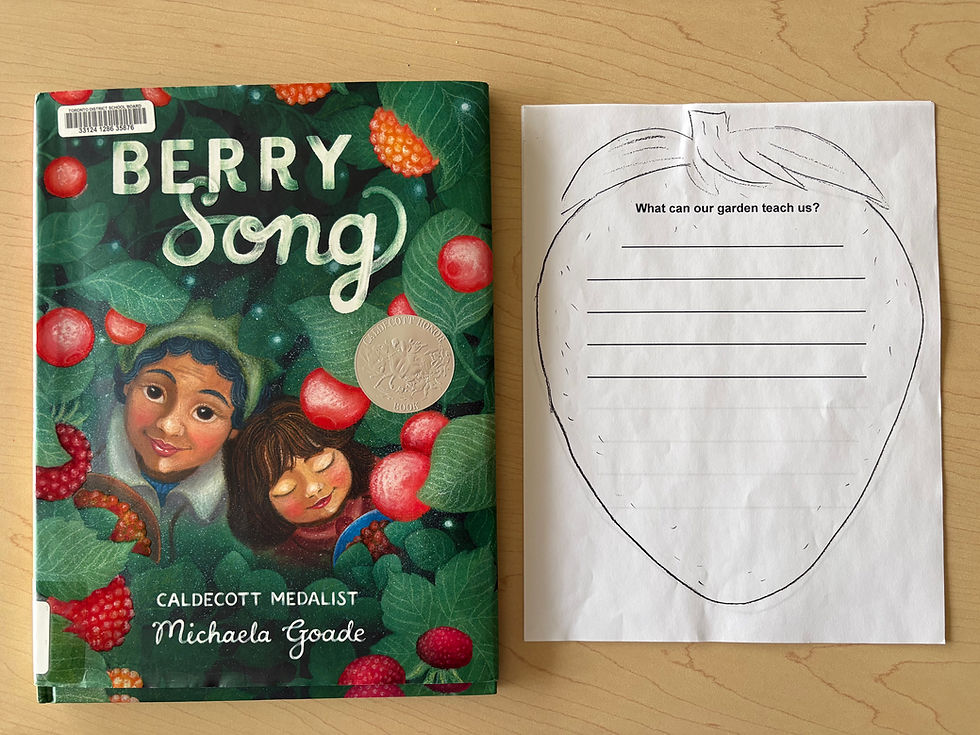
A subsequent school-wide study of Berry Song by Michaela Goade connected literature directly to the school garden and wild strawberries. Through these experiences, environmental learning was ongoing and connected curriculum, community, culture, place, and lived experience.

Branch 4: Moving Towards Sustainability / Breathing with the World
For Jessica, sustainability is rooted in reciprocity, gratitude, and love.
Students learn that caring for the environment is not simply about protecting resources. It is about loving our Earth and taking responsibility to protect our fragile ecosystems.
This understanding is woven into the school’s community garden. Through weekly Eco Club meetings, students remove litter, care for existing plants, prune old growth, and help ensure new plants can flourish.
The garden has become an outdoor, living classroom and a place where students see the results of sustained care over time. They learn that stewardship requires attention, patience, and responsibility to future generations.
Language and song have also become important parts of this learning.
During an Orange Shirt Day event, the school worked with a gifted Elder and learned Nibi’s Water Song. Students and staff were introduced to Anishinaabemowin words such as nibi, meaning water, and miigwech, meaning thank you. Students also took walks along the ravine, visiting Black Creek.
Through language and song, students learned that water is not a resource, rather a living being worthy of gratitude, respect, and care.
These teachings invite students to consider what it means to live reciprocally with the Land and Water around them — and how everyday actions can contribute to the wellbeing of future generations.

Putting It Back Together
The four branches of Jessica’s environmental education practice come together through her ongoing relationship with Land, Water, and the greater community.
Beginning with a spark of curiosity through the Eco Club, this grew through professional learning and her introduction to Traditional and Indigenous Knowledge Systems.
That learning flowed back into her school through the restorative garden, experiential learning, professional development, book studies, and student inquiry.
Today, sustainability is expressed through the ongoing work of caring for Topcliff’s garden, learning from the seasons, building community relationships, and nurturing a loving relationship to the world around us.
Jessica describes this process as ongoing, through listening, learning, and reflecting on her practice.
“I continue this journey of Land and Water stewardship, while breathing into this world the knowledge I have gained.”
That commitment is also reflected in her decision to pursue a Master of Education in Social Justice Education at OISE/UT, where she hopes to further examine her lived experience and positionality.
Integrating Indigenous Perspectives
A central part of Jessica’s environmental education practice is her commitment to learning respectfully from Traditional Knowledge Systems.
She recognizes that her lived experience requires ongoing reflection in order to ethically participate in this work.
Her relationships with Elders and Knowledge Keepers have therefore been foundational in expanding her thoughts on Land, Water, reciprocity, and a loving relationship with our Earth.
She also participates in land stewardship experiences at Black Creek Community Farm, for example, where she has planted a range of restorative plants.
For Jessica, respectful integration requires an ongoing process of listening, relationship-building, reflection, and accountability.
Innovation and Community Impact
Jessica’s innovation lies in bringing environmental education and community-building together through ongoing, school-wide practice.
The restorative garden is at the centre of this work. What began through an environmental grant has developed into an outdoor learning space where students and staff can explore biodiversity, stewardship, reciprocity, and the relationships between humans and the more-than-human world.
The impact extends beyond individual lessons.
Students have developed hands-on relationships with plants, birds, insects, water, and the land around their school. Staff have participated in book studies that have created opportunities for the broader community to engage with environmental perspectives.
The result is an approach in which environmental education becomes part of the culture of the school. Students are not simply learning about sustainability. They are tending a garden, protecting birds, observing seasonal changes, walking along the ravine, learning from Elders and Knowledge Keepers, collecting natural materials, growing plants, and considering their responsibilities to future generations.
Professional Initiative and Community Collaboration
Jessica’s environmental education practice extends through a complex collaborative network of students, colleagues, community members, environmental organizations, and local community partners.
As a member of the school’s Indigenous Staff Committee, she has helped organize school-wide learning opportunities that bridge environmental education and Traditional Knowledge together.
The Be a Good Ancestor book study connected literature with nature walks, art, poetry, and reflection on ancestors and future generations. The Berry Song study has created opportunities to connect Indigenous-authored literature with the school’s wild strawberry garden and seasonal teachings.
Her work demonstrates that environmental education can be both deeply local and deeply relational. A garden outside a school, a walk through a ravine, a song about water, a conversation with an Elder, or a handful of strawberries can all become starting points for understanding our responsibilities to the world around us.
Jessica’s journey continues to evolve. At its heart is a commitment to build loving relationships with Land and Water that help students recognize they are part of a much larger community of life.
By bringing together curiosity, experience, integrated learning, Traditional and Indigenous Knowledge, and action, she is helping students discover that environmental education is an experience guided by our Earth.

Comments